


“I’m sending you some yoga poses to do for stress”
Visualize this; you return from a hectic day at work and text your friend of how exhausted you are. Your body aches and for some reason you can’t sleep, though you need to be at work the next day as early as the sun is up.
Then your friend replies with that quote above along with illustrative pictures to guide you.
You’ll probably think it’s ridiculous at first, because you’re exhausted and all you need is sleep, and not some poses.
Well, let me show you in this article how yoga works, so the next time your friend sends you those yoga poses, you won’t think twice about getting in position.
Or perhaps after reading this article, you may not need to text your friend when next you feel stressed or anxious, but you’d easily take advantage of the 7 yoga poses for stress and anxiety that we’ll be revealing soon.
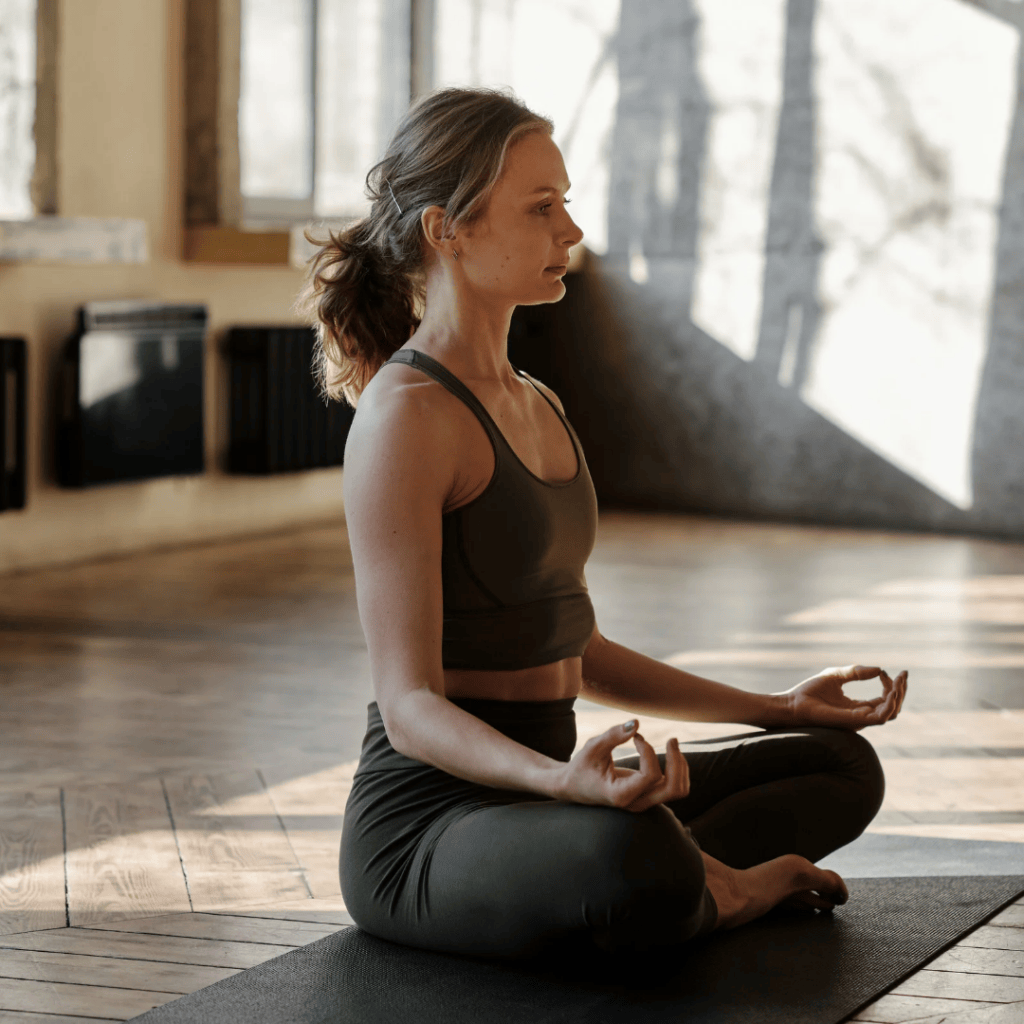
Benefits of Yoga
There are various types of yoga, and though yo is an ancient practice, originally from India, when most people talk about it they refer only to the improved flexibility benefit it offers.
Not to counter this, but there several benefits of yoga and they range from mental to physical body improvement, such as we have listed below;
- Improves Flexibility
Just as we’ve mentioned already, consistently practicing yoga poses will help improve your body’s flexibility.
Not many people know this, but being flexible is not just a flex, but a necessity for better physical performance in any aspect of life or any field of work.
You tend to carry out activities easily without complaining of body aches, and this comes in handy as you age, and luckily, there are several yoga poses for flexibility you can begin practicing.
- Strength and Muscle Building
For strength and muscle building, Hatha and Vinyasa type of yoga are mostly recommended.
These types of yoga promote the use of your body weight to build strength and muscle, instead of using dumb-bells or lifting weight and studies have proved it an effective technique.
- Boosts Immunity
Research is still ongoing, however, there many studies that have shown that a consistent practice of yoga helps to boost the body’s immune system, and thereby help to fight inflammatory diseases like diabetes and arthritis.
- Improves Quality of Sleep
With the recent economic decline, we see more people putting in long hours at work to be able to attain a sustainable comfortable lifestyle, and with that also comes an increase in the number of people who do not sleep well at night because they have over time developed one sleep disorder or another.
The visual imagery we painted at the onset of this article is a typical example of what now happens in the life of many.
But by doing one or two yoga poses, even for 5 minutes before you lay on your bed to sleep will help you fall asleep a lot easier and make you have a restful night so you will wake up refreshed the next morning.
This is because yoga stretches your muscles and joint, hence, eliminating every tension that may be restricting normal blood flow to your body and keeping your body and mind at a calm state so you can sleep well and easily too.
- Improves Body Posture
When you begin to practice yoga, you’ll see that you’ll become more aware of how you position your body both in your resting and active state.
You’ll not want to arch your back over your phone or walk with your shoulders slouched, because the flexibility your body is experiencing makes all those postures that have seem normal to you in the past, begin to be uncomfortable.
And generally this improves your lifestyle.
- Serves as A Natural Way of Relieving Pain
After a workout routine, certain yoga poses are recommended to help relief pain caused by the wear and tear in the muscles.
Also, people who suffer back pain may be advised by their doctor to do certain yoga exercises like the cat-cow or downward facing dog to help with their pain.
- Works for Stress and Anxiety
When it comes to stress and anxiety, I think we can agree that I have subtly hinted that one of the benefits of yoga is to relief stress and anxiety.
A particular type of yoga that does this is the meditation yoga, a type of yoga that combines breathing techniques, physical poses and meditation to achieve serenity and harmony with your inner self and your environment.
Keep that in mind as we move on to discourse further how this type of yoga works for both stress and anxiety.
How Yoga Poses Work for Stress and Anxiety
In 2014, a study showed that 93% of the population have intrusive thought at least once every 3 months, but given the current situation of hardship all over the world, one may assume that it has become more frequent than it was before.
Intrusive thoughts are often unpleasant and trigger to the feeling of stress and anxiety. For some people this leads to an episode of a panic attack, a situation where you may feel incapable of breathing.
Regarding how yoga poses for stress and anxiety works; in yoga, one of the basic instructions is to breathe.
This is because they understand the power of breathing to calm nerves and create a state of mindfulness that makes you aware once you begin experiencing any stress or anxiety symptoms like dry mouth and congested chest.
With this awareness, when this triggers come, you’ll become sensible to control your breath so as to lower you rising blood pressure, improve lung capacity and respiratory function.
The practice of yoga works together with the hypothalamic pituitary of your brain, that controls your fight or flight mode (sympathetic nervous system) and the relax mode (parasympathetic nervous system).
The working together of yoga with SNS and PNS, now makes it possible to reduce the activity of SNS so you easily fall in the rest state in times of stress or anxiety.
Also, yoga plays a role in secretion of hormones.
For instance, a study has shown that yoga can reduce the secretion of cortisol, a stress-inducing hormone, in the blood, and boost secretion of endocannabinoids, a hormone that stimulates calmness.
7 Yoga Poses for Stress and Anxiety
Now you understand and hopefully trust in the power of practicing yoga poses for stress, anxiety and other benefits mentioned earlier.
Let’s consider 7 effective yoga poses that you can pick and make a part of your daily routine to help you relief stress and anxiety:
1. Child’s Pose
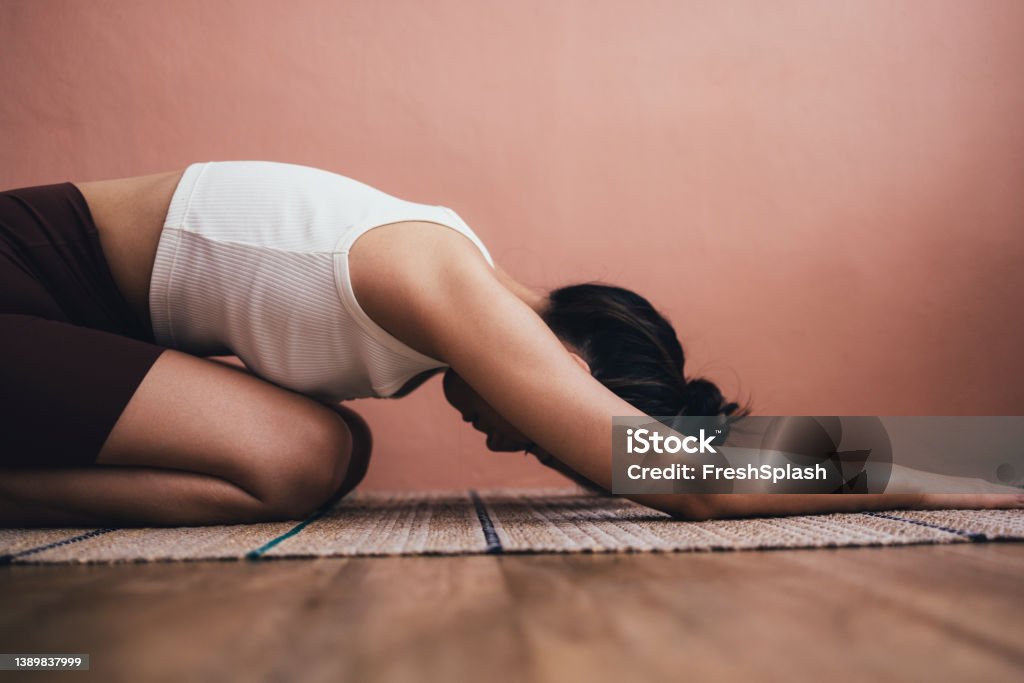
This is a simple relaxing pose that works well for reliving stress tension around the neck, ankles, hips, thighs and lower back.
You want to get in this position after a long day at your computer, especially if you were not seated in a good posture.
Also, getting in the child’s pose when you begin to get an anxiety attack instantly sends a signal through your body to reduce your heart rate so you can feel a sense calm.
To do this pose:
- First get on your knees but keep them slightly apart.
- Sit on the heels of your feet, and slowly lounge your back forward with your both arms extended on the ground.
- Then place your forehead in-between your outstretched arms and breath.
2. Cobra Pose
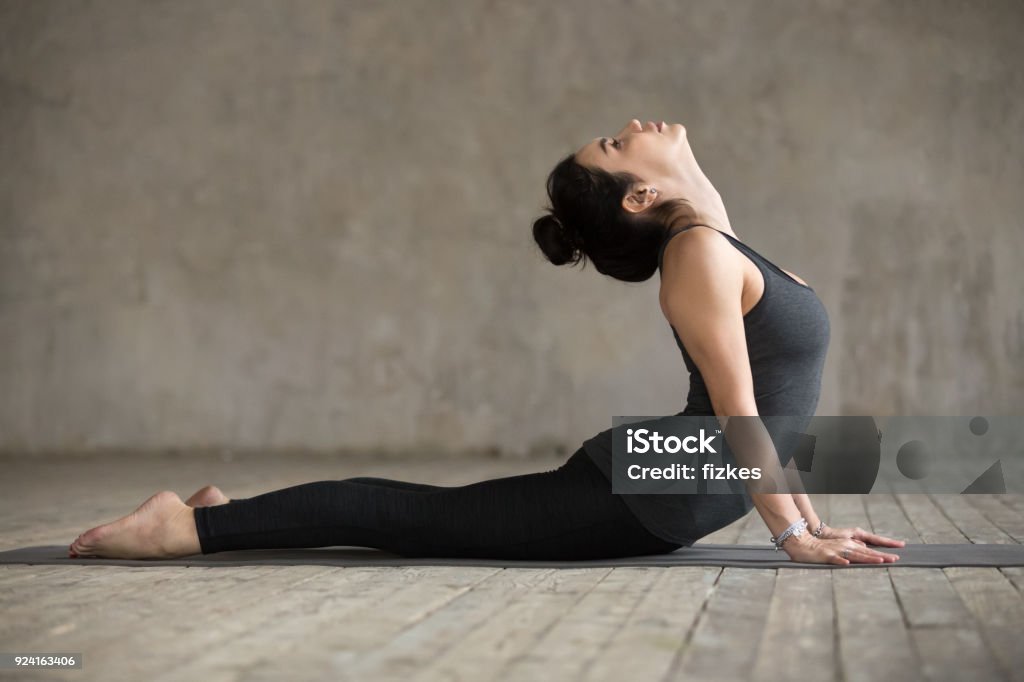
When stress hormones are spiking or an anxiety attack is coming in, you may forget to breath and the lack or reduce oxygen supply encourages both hormone and panic.
This is why in a situation where you’re feeling mentally stressed and become anxious about something you’re told to breath Because the presence of oxygen cuts off all the acting neurons responsible for the feeling.
By doing cobra pose, you stretch the muscles in your chest region, hence expanding the lungs so it can take in as much oxygen as possible. You do this by:
- Lying flat on a mat. Make sure your toes are not pointing but flat on the mat too
- Keep your palms flat and on the same level with your head so that your elbows are facing backward
- Then slowly raise your upper body (your head to waist) off the mat while supporting yourself with your arms that are now straightened
- Draw your head backward, maintain the pose and breath
3. Reclined Twist
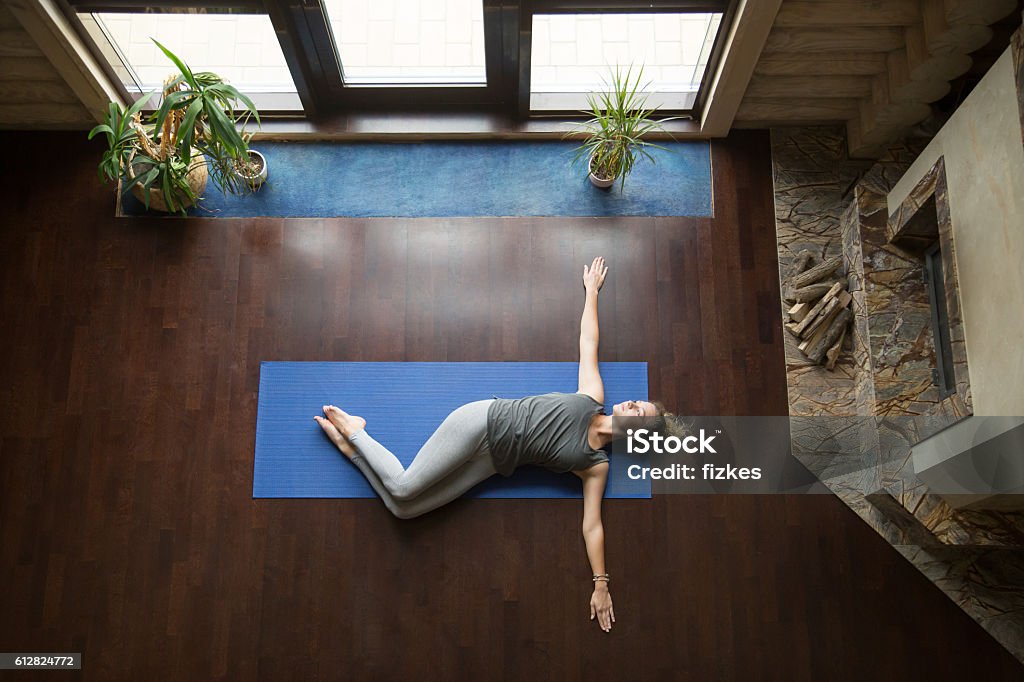
The reclined twist pose is a relaxing yoga pose that can help relief the tension in your lower and upper back, shoulders, chest and spine muscles after a long day and this is how you do it:
- First, lie with your back flat on a mat
- Place your arms sideways and keep your palms facing up
- Keep your legs together and bend your knees to one side
- Bring the bended knees up that your heel is only a hand shy from touching your butt
- Now turn your head in a direction opposite from your knee placement, that is if your knees are facing right then your head should face left
- Maintain the pose, breath and do it on both sides of your body
4. Leg-Up-The-Wall
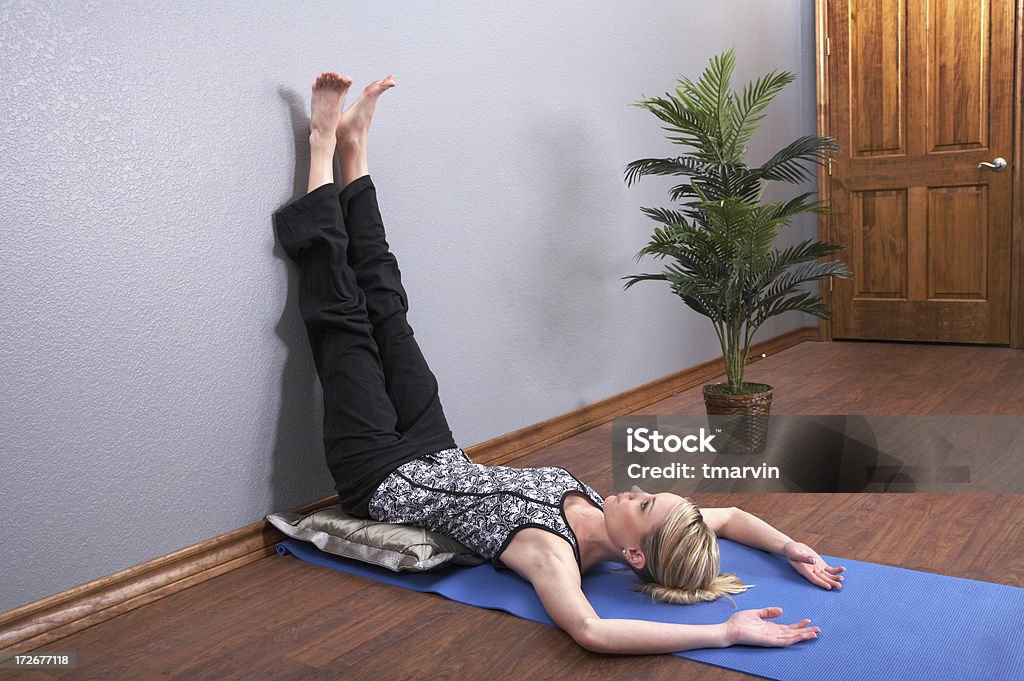
Leg-up-the-wall is probably the simplest yoga pose. It doesn’t necessarily stretch the muscles, but can relieve signs of stress such as back pain.
The principle backing its effectiveness is simple as well. When you’re in this pose, body fluids that have gathered around your lower body travels upward, easing any friction between muscles and joints that are causing the pain.
To do this pose, lie on your back and rest your legs on a wall, just as the name implies.
5. Camel Pose
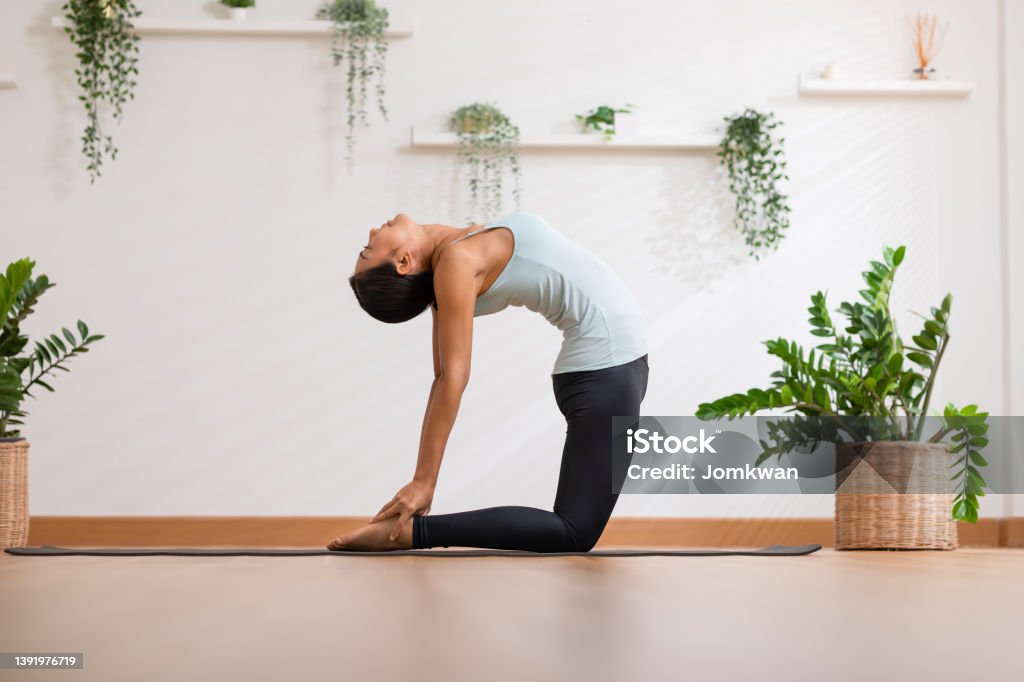
If you slouch when stressed or anxious, then the camel pose is a yoga pose you should try.
At first attempt, you might not get it perfectly because it requires a good amount of flexibility in your chest and spine, but with consistency, comes perfection naturally, so:
- Stand straight on your knees, keeping them inches apart to maintain a balance stance and with arms facing downward
- Slowly push your chest outward, leaning into your back
- As you lean, move your arms backward to touch the heel of your feet
- Maintain the pose and breath
This is another simple yoga pose for stress and anxiety that doesn’t require much activity.
6. Savasana
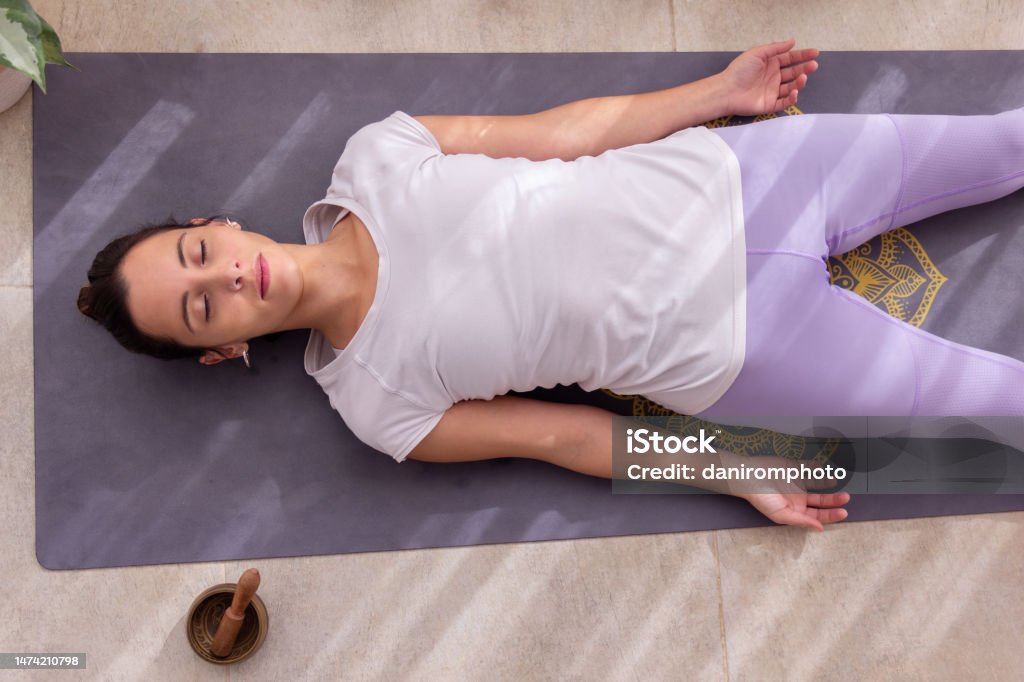
Savasana is also known as the corpse pose because you’ll need to lay like a corpse while doing it.
It is more of a mental type of yoga than it is physical and this is how you do it:
- Set your timer for 10 – 20 minutes and just lie flat on your back
- Close your eyes, remember to breath and relax your body
- While in this pose, clear your mind and only listen to a soothing tune in the background, the chirping of birds, calling of cricket or absolute silence
The pose is a conscious effort to ignore everything making you unrestful as you let the air around you control your body and occupy your mind.
7. Sun Salutation
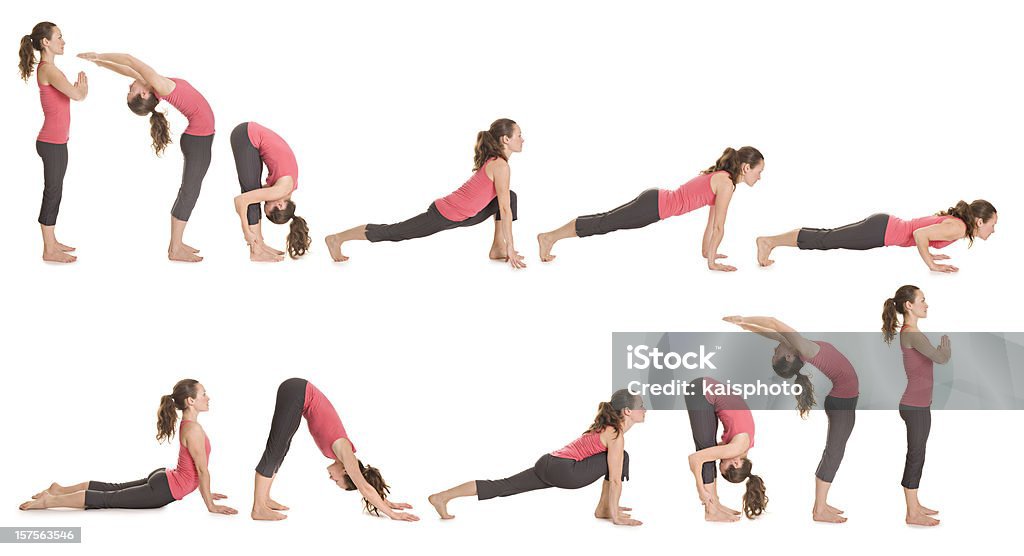
Traditionally, the sun salutation pose is done either at sunrise or sunset while facing the location of the sun, east or west.
It is not a one-movement pose like those we’ve talked about, but a series of movements and yoga poses, that follows a coordinated pattern of breathing.
First thing you’d want to do to begin this yoga pose is stand straight with your hands clapped together as if praying, then follow up accordingly:
- Inhale and raise your arm above your head while your hands remain clasped
- Then exhale and bend your back so your forehead is touching your knees, your hands are holding your ankles, your legs are kept straight. This should leave only a gap between your belly and thighs
- Inhale and let go of your ankle
- Extend your upper body forward so the gap between your belly and thigh widens.
- Suck in your belly and hold the pose with your fingertips on the ground
- Now exhale and put one leg forward and the other back
- Bend your forward knee to put your body in a high lunge pose
- Inhale and place your palms flat on the ground, then push the forward leg backwards to assume a high plank position
- Exhale and lower your body laterally, supporting your weight with your palm and toes pressed to the ground
- Inhale and relax your lower body flat on the ground so you’re in an upward facing dog position
- Now rest your waist downward so it’s only your chest upward that isn’t on the ground (cobra pose)
- Exhale and lift your whole weight from the ground but keep your palms and feet pressed flat on the ground. Keep your head down and belly sucked in
- Inhale and assume the high lunge pose, but this time with your other leg
- Exhale and bring your both legs to stand straight together, with your forehead pressed to your knees and your hands holding your heels
- Inhale and lift your body up, your arms above your head and your hand clasped together
- Finally, exhale and return to the beginning pose with your hands in a prayer pose
Takeaway
You now have 7 yoga poses for stress and anxiety, with directions on how to do them, at your fingertip, it’s now your duty to pick out 3-5 minutes daily to practice.
You can do this immediately you start feeling stressed or anxious, or after a hectic day. They’re all simple, easy to pull off and effective.
You May Also Like:
7 Ways To Unbloat Your Stomach
How Does Walking Improve Sleep?
5 Things To Note When Building A Bedtime Routine Chart
Follow us:


Leave a comment